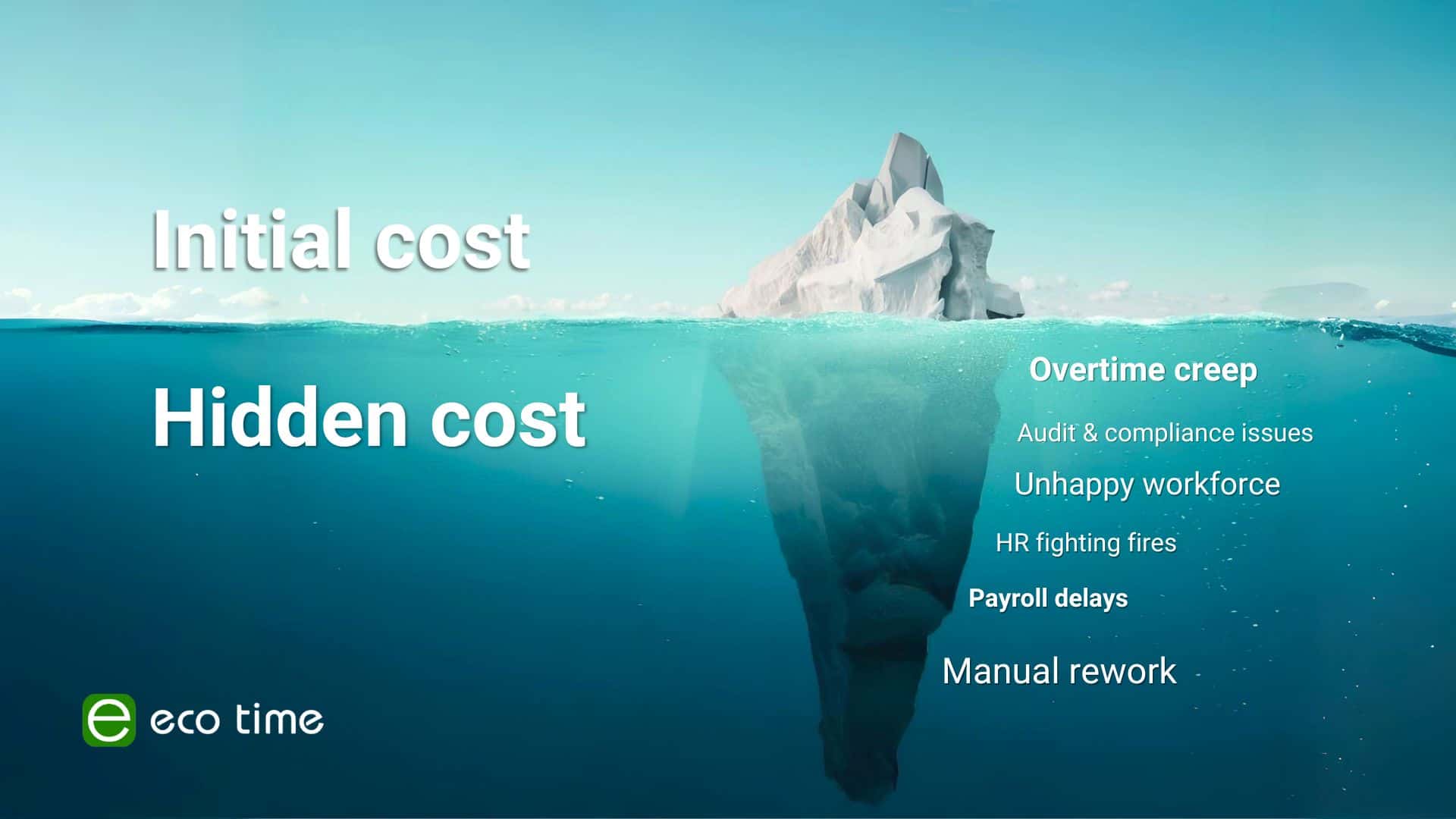

Visualising Savings with Real Operational Impact
Overtime rarely starts as a problem. It begins as a late order, a staff shortage, or a team staying longer to get things done.
The risk isn’t overtime itself. In South Africa, the risk is that overtime shifts from exception to routine and becomes embedded in daily operations as an accepted cost.
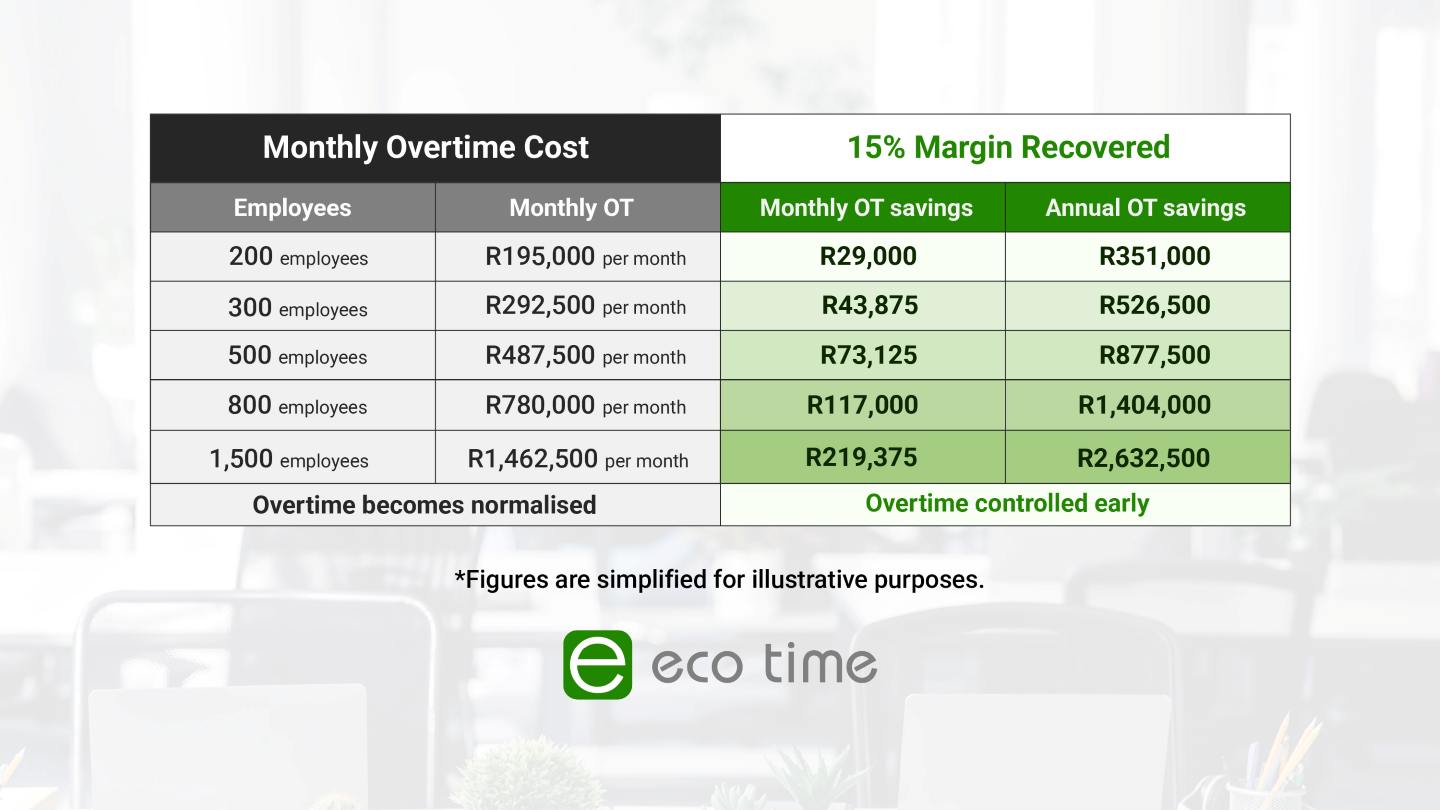
A 15% reduction sounds incremental until you calculate the real overtime cost across your workforce.
The Real Cost of “Just a Bit of Overtime”
Even at minimum wage levels, five overtime hours per employee per week escalate quickly across a large workforce.
(Assumes R30/hour base rate, 1.5× overtime in line with BCEA overtime rules, 5 overtime hours per employee per week.) For a 500-person operation paying R487,500 in monthly overtime, a 15% reduction returns R877,500 per year. That is a measurable overtime cost saving that can be reinvested into the business deliberately.
For South African organisations operating under BCEA overtime rules, costs increase further once premium rates, public holidays, and Sunday pay are included. This makes managing overtime in South Africa especially important for margin control.
And that reflects direct wage cost only.
It excludes absenteeism, fatigue-related errors, safety incidents, and labour disputes that often follow prolonged overtime cycles. When overtime costs become normalised, the impact extends beyond payroll, affecting operational safety, productivity, and workforce stability.
15% is Not Small When it’s Structural
How Overtime Costs Slowly Escalate
Overtime creep rarely comes from a single failure. It accumulates through small operational decisions that no one sees in isolation.
- An employee arrives late but stays longer, triggering overtime
- Work orders finish early, but roster/schedules remain unchanged
- Manual hour calculations introduce avoidable, costly errors
- Coverage overlaps go unnoticed because the full schedule isn’t visible to managers
Each instance feels minor. Together, they create persistent monthly labour costs that are rarely questioned.
If these patterns are only visible when payroll runs, you are not controlling overtime cost; you are absorbing it.
Overtime Is Not a Payroll Problem
Payroll reflects overtime. It does not create it.
Decisions about overtime are made daily: when shifts extend, gaps are filled, or exceptions are allowed “just this once.”
Managers begin planning around it. Teams start expecting it. Budgets slowly absorb the overtime cost. Over time, it becomes embedded in normal labour costs.
Once that happens, reducing overtime feels like a loss to employees.
Reducing Overtime Costs Requires Systems
At scale, manual oversight creates the illusion of control while overtime costs continue accumulating underneath.
Spreadsheets lag.
Emails don’t enforce rules.
Verbal approvals leave no audit trail.
If a system cannot intervene before overtime becomes payable, it is not controlling labour costs; it is documenting them.
An effective overtime management system must prevent excessive overtime before it happens, not simply report it afterwards. Without real-time visibility and enforced shift rules aligned to BCEA overtime rules, organisations struggle to reduce overtime costs sustainably.
What a 15% Overtime Cost Reduction Really Signals
A 15% reduction in overtime cost is not just a saving.
It signals that labour is being scheduled deliberately.
That managers own their decisions.
That inefficiencies are surfaced instead of absorbed.
This is not about working people harder.
It is about leading time intentionally and creating sustainable control over labour costs.
The organisations that successfully reduce overtime costs are not the ones that cut hours aggressively, but the ones that prevent unnecessary overtime early.
The Cost of Doing Nothing
Unmanaged overtime in South Africa becomes normalised, absorbed into budgets, and protected as part of standard labour costs.
Once excessive overtime becomes cultural, the question is no longer what it costs, but how much margin, competitiveness, and pricing flexibility the business is surrendering.
Ready to Reduce Overtime Costs in Your Operation?
Eco Time helps organisations move from overtime reporting to proactive overtime control. With real-time visibility of planned versus worked hours, enforced shift rules aligned to BCEA overtime rules, and integrated rostering, leaders gain control at the moment decisions are made, not weeks later.
If you’re ready to reduce overtime costs and see what a 15% reduction in overtime costs could mean for your business, we’ll help you model the impact using your real numbers.